Mary Berry-Inspired Dundee Cake
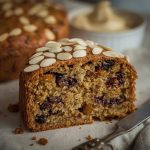
This Mary Berry-inspired Dundee Cake is a rich, buttery fruit cake packed with sultanas, raisins, currants and mixed peel, finished with a neat circle of blanched almonds. The crumb is moist and tender, with a gentle warmth from mixed spice and a touch of orange zest. It slices beautifully and keeps well, making it a reliable bake for teatime or celebrations.
- Prep Time: 25
- Cook Time: 150
- Total Time: 175
- Yield: 12 1x
- Category: Baking
- Method: Baking
- Cuisine: British
Ingredients
- 250g unsalted butter, softened, plus extra for greasing
- 200g soft light brown sugar
- 4 large eggs
- 250g plain flour
- 1 tsp baking powder
- 1 tsp mixed spice
- ¼ tsp fine sea salt
- 200g sultanas
- 150g raisins
- 100g currants
- 50g mixed peel, finely chopped
- 1 orange, finely grated zest only
- 50g ground almonds
- 2 tbsp whole milk
- 50g blanched almonds, whole, for topping
Instructions
- Preheat the oven to 150°C (130°C fan) / gas 2. Grease a 20cm round deep cake tin with butter and line the base and sides with baking parchment, making sure the parchment comes at least 5cm above the rim to protect the cake as it bakes.
- In a large mixing bowl, beat the softened butter and soft light brown sugar together with a wooden spoon or electric hand whisk for 3–4 minutes until pale and fluffy. Scrape down the sides of the bowl with a spatula so the mixture beats evenly.
- Add the eggs one at a time, beating well after each addition. If the mixture starts to look curdled, beat in 1 tbsp of the measured plain flour before adding the next egg; this brings it back together.
- Sift the remaining plain flour, baking powder, mixed spice and fine sea salt into the bowl. Add the ground almonds and fold everything together gently with a large metal spoon until just combined, stopping as soon as no streaks of flour remain.
- Stir in the sultanas, raisins, currants, mixed peel and orange zest, then add the milk and fold until evenly distributed. The mixture should be thick enough to hold its shape but soft enough to drop from the spoon with a gentle shake.
- Spoon the mixture into the prepared tin and level the surface with the back of a spoon, pressing it gently into the corners so there are no air pockets. Arrange the blanched almonds in concentric circles over the top, starting from the outside and working inwards, leaving a small gap between each almond.
- Bake in the centre of the oven for 2 hours to 2 hours 30 minutes, until a skewer inserted into the centre comes out clean and the cake feels firm to the touch. Check after 1 hour 30 minutes; if the top is browning too quickly, cover loosely with a double layer of baking parchment or foil.
- Leave the cake to cool in the tin for 15 minutes, then turn out onto a wire rack, peel away the parchment and leave to cool completely. The cake is ready to eat once cold, but the flavour deepens if wrapped and stored for 2–3 days before slicing.
- To serve, cut into 12 slices using a sharp serrated knife, wiping the blade between cuts for neat portions. Store the cake in an airtight tin, and it will keep moist for up to 2 weeks.
Notes
Store the cooled cake in an airtight tin at room temperature for up to 2 weeks; the flavour improves after 2–3 days. For longer storage, wrap the cake tightly in baking parchment and then cling film and freeze for up to 3 months; defrost overnight at room temperature before serving. The cake can be made up to 1 week ahead and kept in a cool, dry place. There is no need to reheat; serve at room temperature. If you prefer a lighter top, cover the cake loosely with foil after 1 hour 30 minutes of baking to prevent over-browning.
Nutrition
- Calories: 398
- Sugar: 38.5g
- Sodium: 78mg
- Saturated Fat: 9.2g
- Carbohydrates: 52.1g
- Fiber: 2.4g
- Protein: 5.6g
- Cholesterol: 93mg
Keywords: Mary Berry Dundee cake, Dundee cake recipe, fruit cake, British baking, almond fruit cake, classic Dundee cake, teatime cake, easy fruit cake, Mary Berry inspired, sultana cake, mixed peel cake, traditional British cake
Find it online: https://maryberrydishes.uk/mary-berry-dundee-cake-recipe/